




How to Choose the Right Filter Bag for High-Temperature Applications?
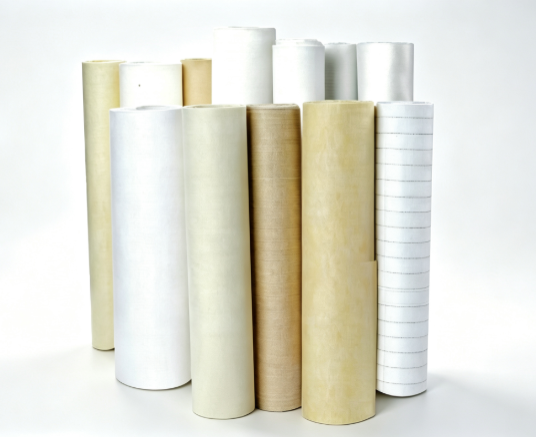
When a filtration system operates at high temperatures, choosing the right filter bag is more than a matter of filtration accuracy. Temperature resistance, chemical compatibility, sealing method, and bag size all have a direct impact on service life and filtration performance.
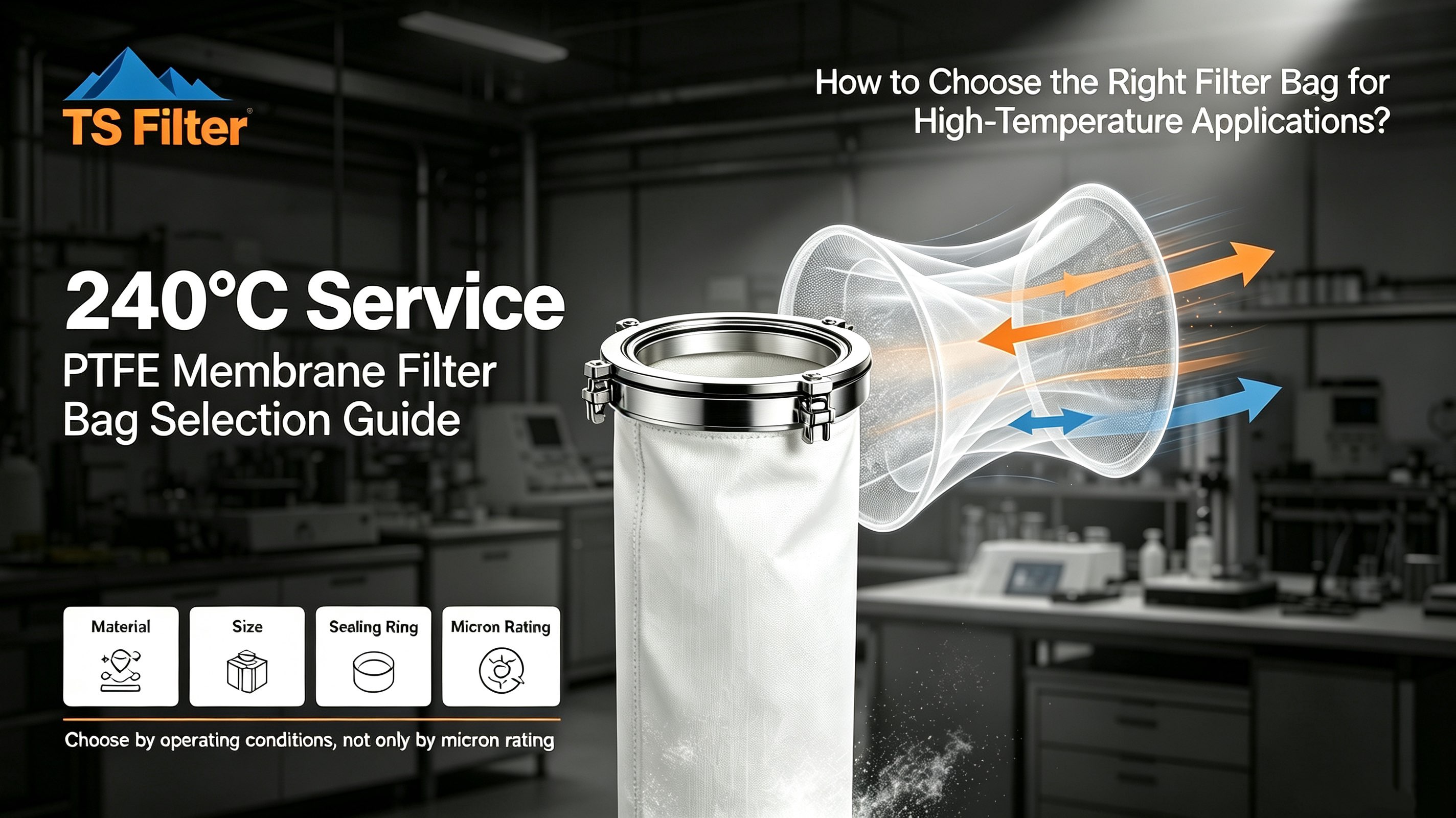
For applications around 240°C, conventional synthetic filter bags such as PP, PE and common nylon materials are generally unsuitable. The filter material must be selected according to the actual operating conditions.
Filter Bag Selection for 240°C Service
For long-term operation at around 240°C, PTFE membrane filter bags are a suitable choice for demanding high-temperature applications.
PTFE offers:
- Excellent high-temperature resistance, with continuous service capability up to around 260°C depending on the specific product and operating conditions
- Outstanding resistance to acids, alkalis and many aggressive chemicals
- Low surface adhesion, helping contaminants release more easily during cleaning
- PTFE membrane filtration for efficient surface particle capture
- Good dimensional stability in demanding industrial environments.
Typical applications include high-temperature flue gas filtration, carbon recovery, chemical processing, and high-temperature catalyst filtration.
It is important to note that while PTFE provides excellent chemical and temperature resistance, its mechanical properties and installation requirements should also be considered. Proper sealing and protection from excessive gas-flow impact can help extend filter bag service life.
Choosing the Correct Filter Bag Size
Filter bags are commonly identified by standard sizes such as No. 1, No. 2, No. 3, No. 4 and No. 5. Their dimensions and filtration areas vary, so the correct size should be selected according to the filter housing and required flow rate.
| Filter Bag | Diameter | Length | Max. Flow Rate* |
|---|---|---|---|
| No. 1 | 180 mm | 430 mm | 20 m³/h |
| No. 2 | 180 mm | 810 mm | 40 m³/h |
| No. 3 | 105 mm | 230 mm | 6 m³/h |
| No. 4 | 105 mm | 380 mm | 12 m³/h |
| No. 5 | 150 mm | 560 mm | 18 m³/h |
*Actual flow rate depends on the liquid or gas properties, filtration media, pressure and operating conditions.
Filter Bag Ring and Sealing Options
The sealing ring is another detail that should not be overlooked. Common options include PP plastic rings and stainless-steel rings.
| Ring Type | Characteristics & Application Scenarios |
|---|---|
| PP plastic rings | Widely used where good chemical resistance and flexibility are required |
| Stainless-steel rings | More appropriate for applications involving higher temperatures, mechanical stress or corrosive environments |
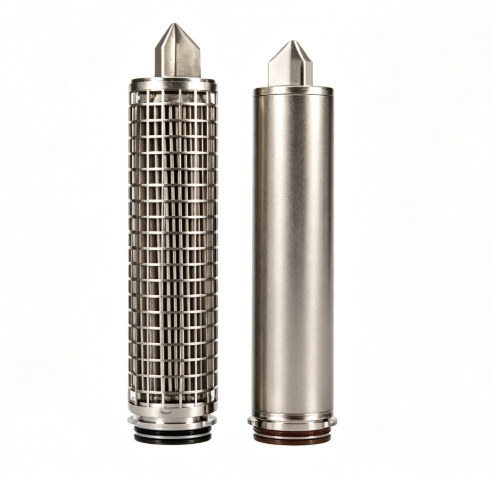
For high-temperature service, a sewn stainless-steel ring design can provide better mechanical durability than conventional plastic-ring construction.
Mesh and Micron Ratings Are Not the Same
Filter bags may be specified by either mesh number or micron rating, but these two terms should not be treated as an exact one-to-one conversion.
In general, a higher mesh number indicates smaller openings and finer filtration.
| Mesh Number | 80 | 100 | 125 | 150 | 200 | 250 | 300 | 350 | 400 | 500 | 600 | 800 | 1000 | 1200 | 1400 | 1600 | 2000 | 2500 | 5000 | 8000 |
|---|---|---|---|---|---|---|---|---|---|---|---|---|---|---|---|---|---|---|---|---|
| Approximate Pore Size (μm) | ≈180-200 | ≈150 | ≈125 | ≈106 | ≈74 | ≈61 | ≈48-53 | ≈43 | ≈38 | ≈25-30 | ≈20-25 | ≈15-18 | ≈13-15 | ≈10-12 | ≈8-10 | ≈6-8 | ≈4-6 | ≈3-4 | ≈1-1.5 | ≈0.5-0.8 |
Actual filtration performance can vary with the wire diameter, weaving method, filter material and manufacturing process. Therefore, when ordering filter bags, it is important to confirm whether the required specification is based on mesh or micron rating.
The Key Point
For high-temperature filtration, material selection comes first. At around 240°C, PTFE filter bags are a reliable option for applications requiring both high-temperature and chemical resistance. At the same time, the bag size, sealing ring, filtration rating and actual process conditions should all be checked before final selection.
Choosing the right filter bag means matching the material and construction to the real operating conditions—not simply selecting a filter by micron rating.