


How to Choose the Right Fermentation Broth Clarification Method for Bioprocess Downstream Purification
Fermentation broth clarification serves as the first critical step in downstream purification for bioproducts, including yeast-expressed recombinant proteins and polypeptide drugs. The core objectives of clarification are to remove cell debris, large aggregates, host cell protein (HCP), colloids, insoluble impurities and host cell nucleic acid, preparing feed liquid for subsequent capture, intermediate purification, polishing and formulation filling.
A range of technologies are available for broth clarification: centrifugation, depth filtration, tangential flow filtration (TFF), dead-end membrane filtration, plate-and-frame filtration, precipitation/flocculation and rotating disc membrane systems. The selection of an appropriate clarification route depends on broth characteristics, target product properties, production scale, budget and downstream process requirements.
| Technology | Working Principle | Advantages | Limitations | Typical Application Scenarios |
|---|---|---|---|---|
| Centrifugation | Separates cells and debris rapidly by density difference. Disc stack centrifuges are the gold standard for large-scale bioprocessing. | Fast continuous processing, high throughput for high-solid feedstock | High capital cost; shear force may damage target products; supernatant usually requires further polishing | Monoclonal antibody fermentation harvest, large-scale biotech manufacturing |
| Depth Filtration | Porous media captures particles both on the surface and inside its tortuous pore structure | Effective removal of fine particles and colloids; no obvious filter cake formed | Single-use consumables; risk of target molecule adsorption by media | Post-centrifugation polishing, fine particle prefiltration |
| Tangential Flow Filtration (TFF / Crossflow Filtration) | Liquid flows parallel to the membrane surface. Cross-flow scours away filter cake while permeate passes through the membrane | Strong anti-fouling performance, stable flux; one system supports clarification, concentration and buffer exchange; easy scale-up | High cost for equipment and membrane consumables; critical parameters need optimization; shear damage risk | Large-scale biopharma: mAbs, vaccines, high-value enzymes |
| Dead-end Membrane Filtration | Fluid passes vertically through fixed-pore-size membranes (0.22 μm /0.45 μm) | Excellent clarity, sterile grade; high product recovery; GMP compliant | Easy clogging, limited loading volume; high disposable filter cost | Final sterile filtration and polishing for low-solid, high-value products |
| Plate-and-Frame Filtration | Feed flows vertically through filter cloth; filter cake forms with filter aid addition | Handles high-solid & high-viscosity broth; low equipment investment | Labour-intensive; limited clarity; risks of product adsorption and contamination | Traditional fermentation: antibiotics, organic acids, crude enzyme pre-clarification |
| Precipitation / Flocculation | Add salt, solvent or flocculant to aggregate colloids and protein particles | Low operating cost | Introduces new impurities; may cause target product denaturation | Pre-treatment for hard-to-filter broth such as amylase and polysaccharide |
| Rotating Disc Membrane | Disc membrane rotates at high speed to create crossflow turbulence and prevent filter cake accumulation | Ultra-low turbidity (<1 NTU); no consumables; resistant to strong acid and alkali; suitable for ultra-high viscosity feed | Relatively high initial equipment investment | Challenging high-concentration/viscous materials unsuitable for conventional filtration |
Key Factors to Select Clarification Strategy
Process developers evaluate five core factors before finalizing the clarification workflow:
- Fermentation broth features: Solid content and cell density are primary indicators. Centrifugation or TFF is preferred for high-solid broth; dead-end filtration suits low-solid feed.
- Target product property & value: For high-value, shear-sensitive products like vaccines and certain enzymes, low-shear pump options such as peristaltic pumps should be adopted. Plate-and-frame filtration should be avoided for products with strong adsorption to filter aids.
- Manufacturing scale: Laboratory-scale testing commonly uses bench centrifuges plus dead-end filters. Pilot and commercial production rely on continuous operations including disc centrifuges and TFF.
- Cost budget: Balance capital expenditure and operating cost. Plate-and-frame filtration cuts consumable cost but requires heavy labour; centrifuges enable fast processing with high upfront investment; TFF delivers good yield at higher equipment and membrane cost.
- Downstream requirements: Target clarity, sterilization needs, salt concentration and pH specifications for subsequent chromatography steps.
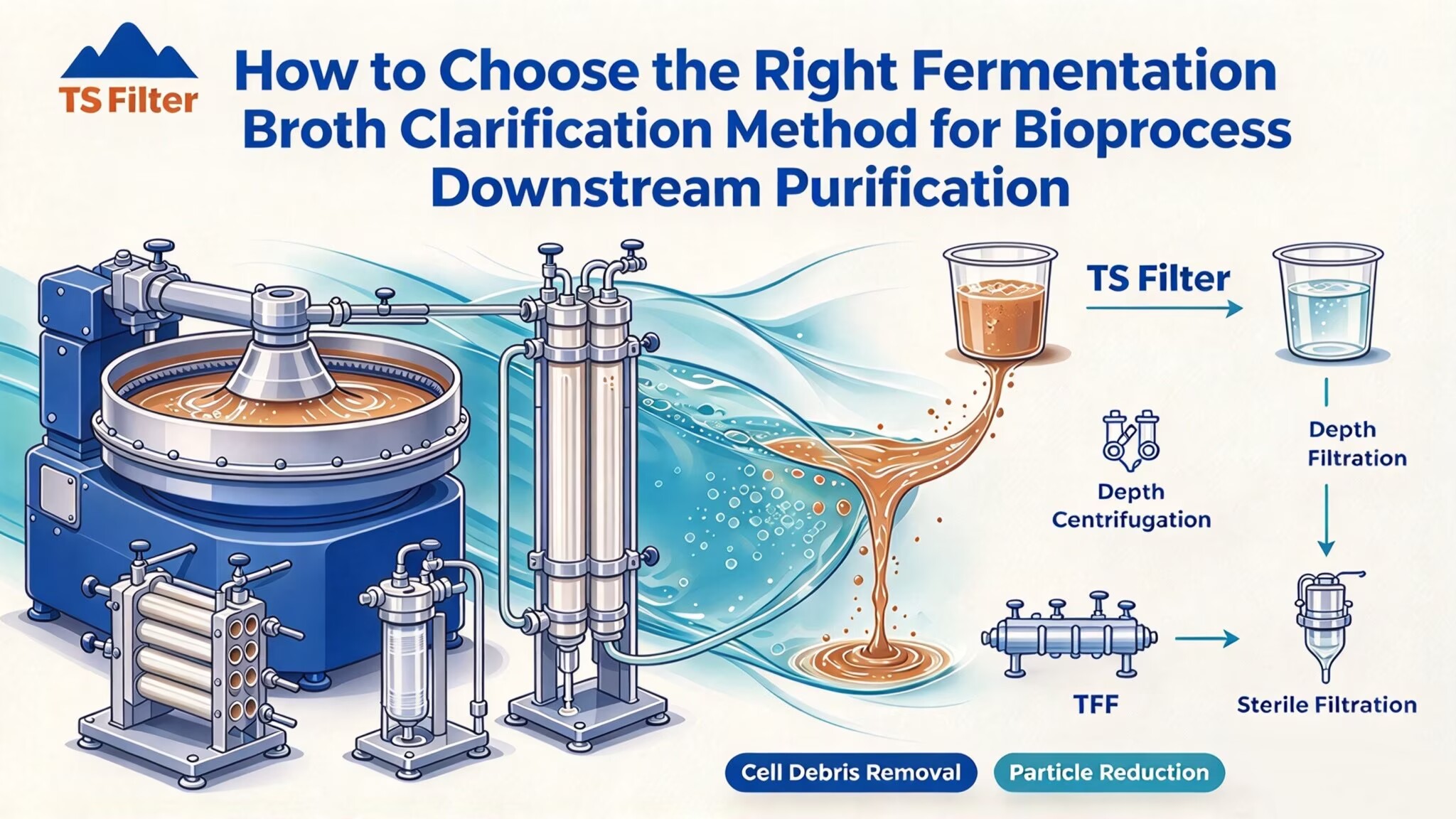
The mainstream workflow widely adopted in modern biopharma: Centrifugation → Depth Filtration → TFF or Dead-end Sterile Filtration Centrifugation removes most solids. Depth filtration works as prefiltration to eliminate fine particles. Final membrane filtration ensures filtrate clarity and sterility before further purification.